← Back home
Geotab · Case 03

Product updates & release notes

A purpose-built, filter-first product updates tool for Geotab's partners — where missing a safety change or regional compliance update carries real business consequences. Designed, tested, and shipped as part of DSSS Phase 3. UX score improved from Grade D to Grade B (+78%) in under three weeks of structured testing.

Role
Lead Product Designer
Partners
Product Operations · Partners (research) · Web Dev
Shipped
December 2025 · DSSS Phase 3
Approach
Build, not buy · 0→1 · Research-led
The problem

Partners had to read the entire internet to stay current

Geotab's product changes carry real consequences for partners — resellers who manage fleets for their customers. A safety-related update, a regional rollout, a FedRAMP compliance change: missing any of these can mean advising customers incorrectly, deploying to regions before a feature is available, or being caught off guard by a limitation that affects their business.

Before the redesign, staying current required reading entire monthly articles manually — no filtering, no targeted search, no way to scope to a region or product category. Two separate pages existed ("Product Updates platform" and "Product Update platform") with confusing overlapping content and broken filtering on one of them. There were no permalinks to specific features, so sharing a specific change with a colleague meant linking to a wall of unrelated text.

I ran a structured UX Scorecard evaluation (SEQ + Satisfaction + Cognitive Demand + UMUX Lite) with 4 partners against a real task: "Compile a report of all the Safety changes made to MyGeotab in the past 6 months."

2.05/5
UX Score — old experience · Grade D (Poor)
6
Journey stages, all trending negative — from Neutral → Frustrated → Angry → Exhausted/Defeated
4
Critical failures: no global filters, no permalinks, duplicate broken pages, full manual copy-paste

"There is Product Updates platform and Product Update platform… why? The Product Update one has filtering that doesn't work."

Partner participant, UX Scorecard — Old Experience, Nov 21, 2025

"No good starting point — Google to then a random month then backtrack."

Partner participant, UX Scorecard — Old Experience, Nov 21, 2025

"No source of truth — copy and pasting raw content."

Partner participant, UX Scorecard — Old Experience, Nov 21, 2025

UX Scorecard for old Product Updates experience showing Grade D rating, Partner persona, journey map with negative emoji sentiment (frustrated, angry, exhausted), and scoring matrix with low ratings across all stages
UX Scorecard — old experience · Grade D (2.05/5) · Partner persona · Journey sentiment goes from neutral to exhausted/defeated · Product Updates | UX Scorecard.jam
Research & process

Build our own — and learn the partner workflow first

Geotab already had release notes content. The problem wasn't content — it was navigation, structure, and audience fit. I chose to build a custom tool rather than buy a generic release-notes platform specifically because the partner workflow is different from an end-customer workflow: partners need to filter by region (so they know what applies to their customers), by FedRAMP compliance (for government fleet accounts), by release status (to plan ahead vs. communicate completed changes), and by product area (so they can scope to what's relevant).

  1. Competitive analysis. Documented how Figma, Semrush, Salesforce, and Atlassian handle release notes and product updates — identified the patterns worth borrowing (filterable topic tags, individual permalink pages, release status signals) and the gaps Geotab needed to close.
  2. Partner journey mapping. Mapped the full workflow from task receipt ("my manager asked me to compile safety changes") through internal document → site navigation → article reading → manual extraction → final report. Exposed the 6-stage degradation in sentiment and identified which steps generated the most friction.
  3. Formative evaluation — old experience. 4-participant UX Scorecard (Nov 21, 2025). Structured scoring against the real partner task. Generated the Grade D baseline and a specific list of critical, important, and minor issues to address.
  4. Cross-functional design with Product Operations. Embedded with the team that authors and publishes updates to understand the CMS structure, tagging taxonomy, and publication workflow — so the front-end design was grounded in what was actually achievable with the backend.
  5. Formative evaluation — new experience. 11-participant UX Scorecard (Dec 10, 2025) — nearly 3× the original cohort, reflecting broader stakeholder interest in the result. Structured against the same task and scoring rubric.
The solution

Filter-first, partner-first, consequence-aware — shipped December 2025

A custom product updates tool built around how partners actually consume change information — not how Geotab authors it. The design choices map directly to the research findings:
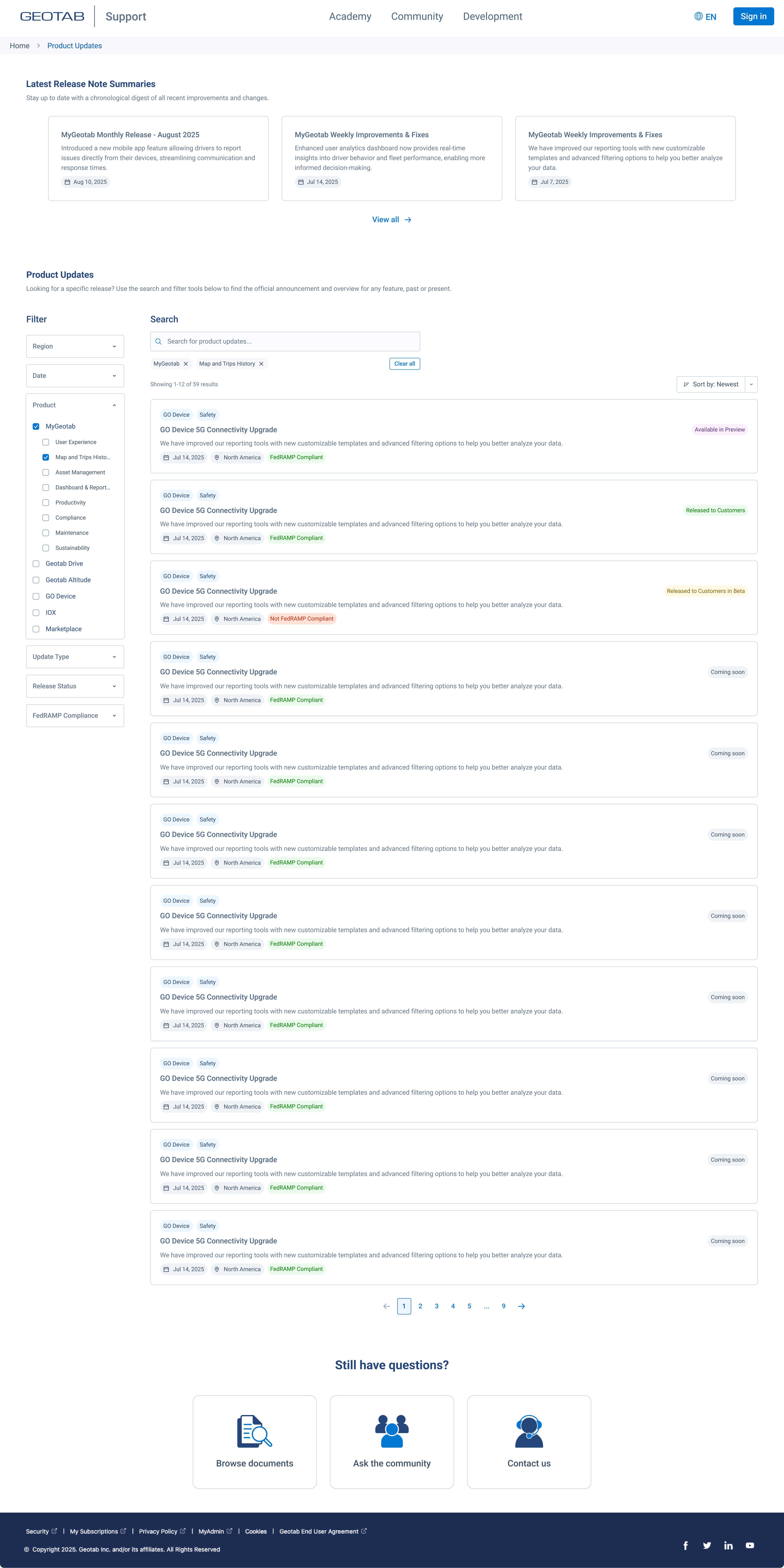
Product Updates homepage with active filters: MyGeotab and Map and Trips History selected, showing 39 results sorted by newest. Left panel shows Region, Date, Product checkboxes, Update Type, Release Status, and FedRAMP Compliance filters. Results show GO Device Safety updates with North America region, FedRAMP Compliant badges, and varying release status tags (Available in Preview, Released to Customers, Released to Customers in Beta, Coming soon)
Filter-first homepage — active filters (MyGeotab · Map and Trips History) returning 39 results, each tagged with region, FedRAMP status, and release stage · Launched December 2025 · Product Updates.fig
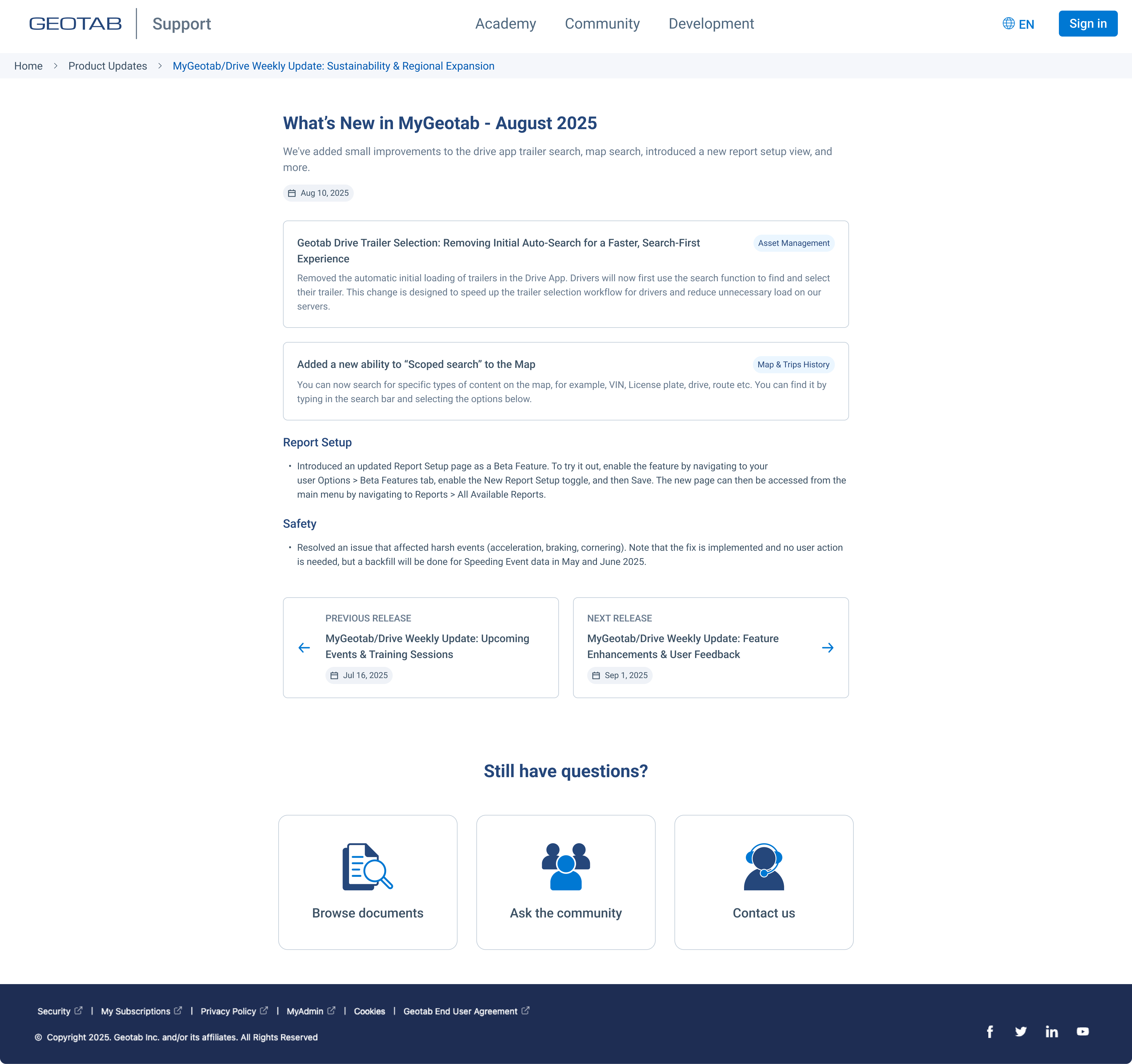
Release note summary page 'What's New in MyGeotab - August 2025' showing individual feature cards with category tags (Asset Management, Map & Trips History), previous/next release navigation, and Still have questions footer
Release note summary — structured monthly digest with individual feature cards, category tags, and previous/next navigation · Product Updates.fig
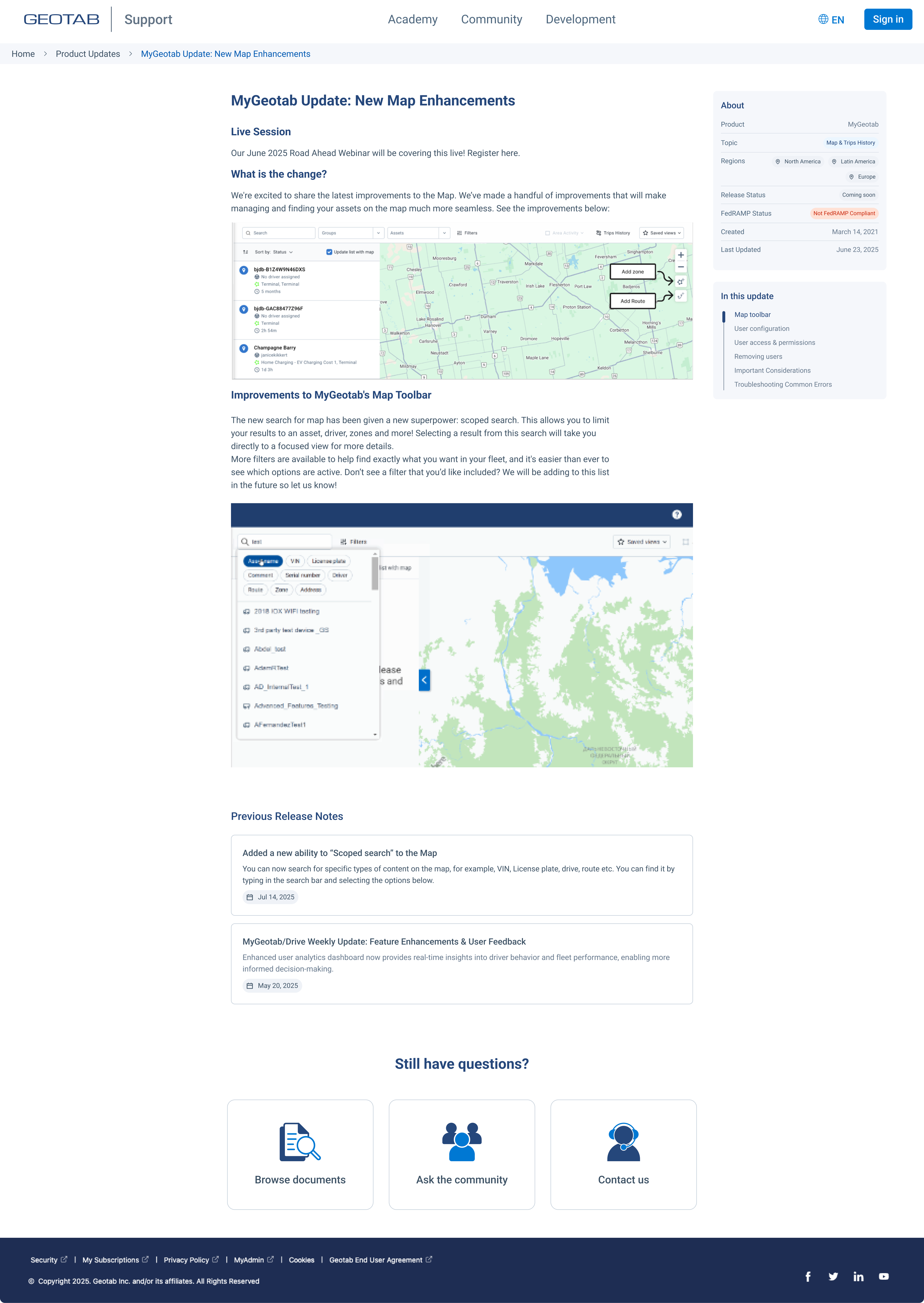
Individual product update page 'MyGeotab Update: New Map Enhancements' with right sidebar showing Product, Topic, Regions (North America, Latin America, Europe), Release Status (Coming soon), FedRAMP Status (Not FedRAMP Compliant), Created and Last Updated dates, and In this update section navigation
Individual update page — per-region metadata, FedRAMP status, release stage, and in-update navigation sidebar · Product Updates.fig
Results

Grade D → Grade B · +78% in three weeks

The new experience was re-evaluated against the same task and rubric with 11 participants (Dec 10, 2025) — nearly 3× the original cohort. The score jumped from 2.05 to 3.65 out of 5 — a +1.60 point improvement (+78%), moving from Grade D (Poor) to Grade B (Meets Expectations).

3.65/5
UX Score — new experience · Grade B (Meets Expectations)
+78%
Score improvement · +1.60 pts · from Grade D to Grade B in under 3 weeks
11
Participants tested — nearly 3× the original cohort, reflecting broader stakeholder confidence
UX Scorecard for new Product Updates experience showing Grade B rating, same Partner persona and journey map but with dramatically more positive emoji sentiment and higher scoring across all stages compared to the old experience
UX Scorecard — new experience · Grade B (3.65/5) · Same task, same rubric · Journey sentiment trends positive throughout · Product Updates | UX Scorecard.jam

Participant quotes from the new experience tell the story clearly:

"Using date filter and safety tags — very efficient, took me less than 5 seconds."

Partner participant, UX Scorecard — New Experience, Dec 10, 2025

"Simple and effective to just search for a keyword and then filter by time — took me less than 5 seconds."

Partner participant, UX Scorecard — New Experience, Dec 10, 2025

"Nice filter options — this was very easy."

Partner participant, UX Scorecard — New Experience, Dec 10, 2025

Remaining gaps identified for future iteration: the entry point is still hard to find without a Google search, "Safety" isn't yet a first-class filter chip, and there's no bulk export for partner report generation. These became the documented opportunity list for Phase 4.

This deliverable was confirmed in the DSSS Phase 3 closure (April 27, 2026): "CSH product updates landing page launched with filters, structured CMS backend, and full search functionality." The launch also created a durable relationship with Product Operations and opened a direct research channel into the partner segment — a hard-to-reach user group that was previously unserved by any dedicated UX research.