Role
Lead Product Designer (sole UX)
Sole UX designer on a company-wide, COO-sponsored initiative to transform Geotab's fragmented six-system support stack into a single, AI-powered hub. From turning raw Superset data into a costed executive roadmap, through shipping the Central Support Hub, in-app Help panel, and the GIA for Support agent console — to ongoing research shaping Phase 4.
Geotab's support ecosystem was — and still is, mid-migration — six independent systems: the Support site, Community, Academy, Dozuki, RightAnswers, and Geotab.com. Users had to guess which one to visit. Support agents had no unified workspace. There was no shared metric, no shared roadmap, and no shared ownership of the problem.
The company launched the Digital Self-Service Support (DSSS) initiative in 2024: a multi-year, COO-sponsored programme to consolidate everything into a single, AI-powered Central Support Hub. I was the sole UX resource across the full initiative — responsible for research, strategy, design, and delivery from Phase 1 through the current Phase 4.
The conventional narrative blamed hardware and external complexity. The data said otherwise. I pulled ticket volumes from Superset (dashboards 3141 / 4205 / 11412) and the pattern was unambiguous: the MyGeotab UX layer generates nearly as many tickets as all hardware categories combined.
Source: Superset "Top 10 Ticket Trends - MoM" (chart 25825), May 2026. Blue = hardware categories.
On top of the ticket data: a 2023 support survey (544 responses) showed 50% of users unable to find what they were looking for — and 52% of those then contacted human support, cascading a self-service failure directly into operational cost. The same pattern appeared in 2,197 more recent survey responses (Superset chart 64417), including verbatims like: "I have even used outside AI to help with Geotab questions." Users were leaving the product to solve product problems.
"The chat function is poor… I have urgent requests and it's frustrating when there is nobody to assist. I have even used outside AI to help with Geotab questions."
City of Portland · CSAT 50% — Superset Survey Summary (chart 64417), 2,197 responsesThe first deliverable wasn't a design — it was a Support UX Insights report: a prioritized, costed breakdown of the support problem that made the revenue-at-risk visible and gave product and operations a shared, fact-based roadmap instead of a wishlist. This became the P0/P1 alignment tool for the entire initiative.
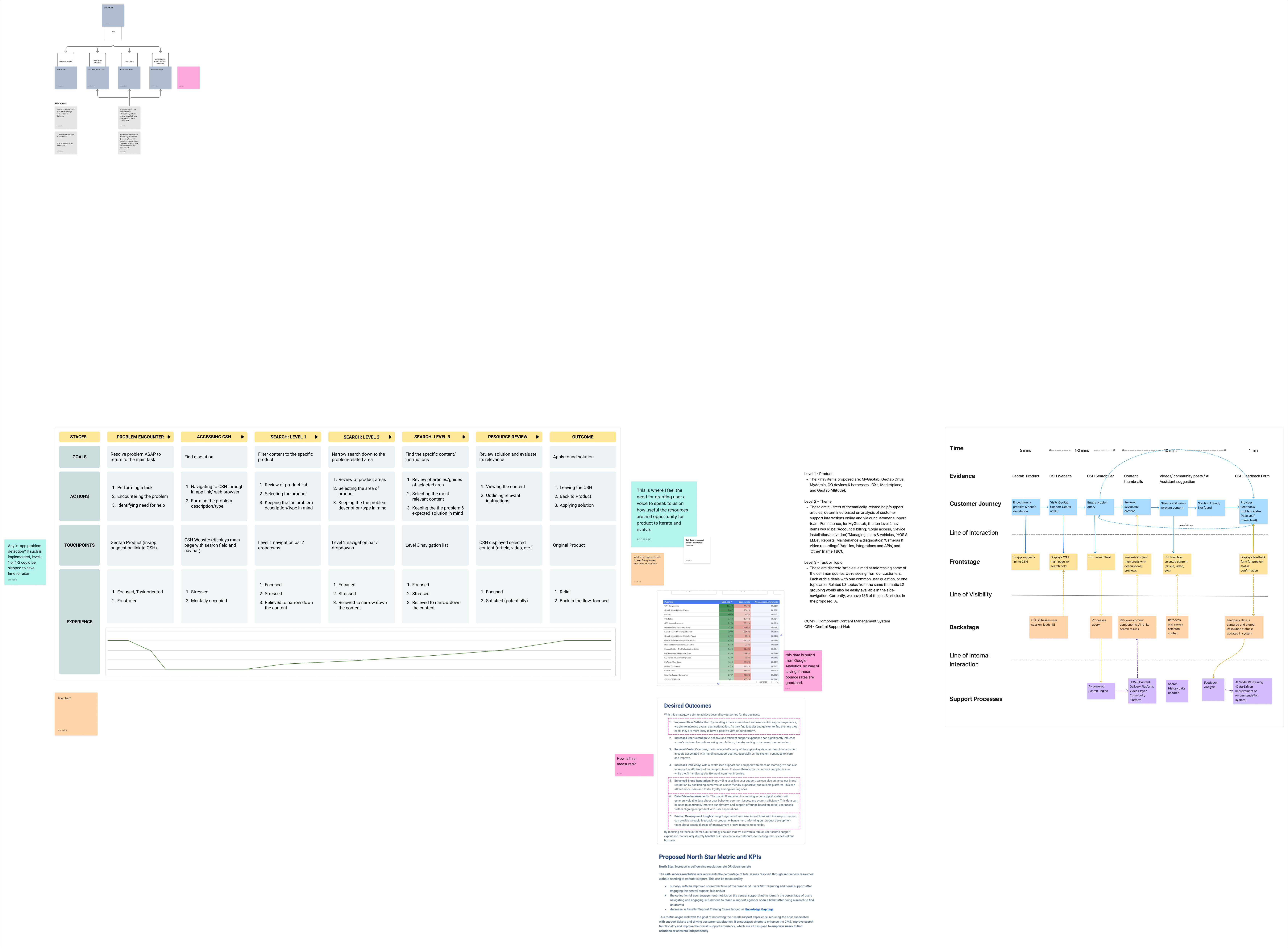
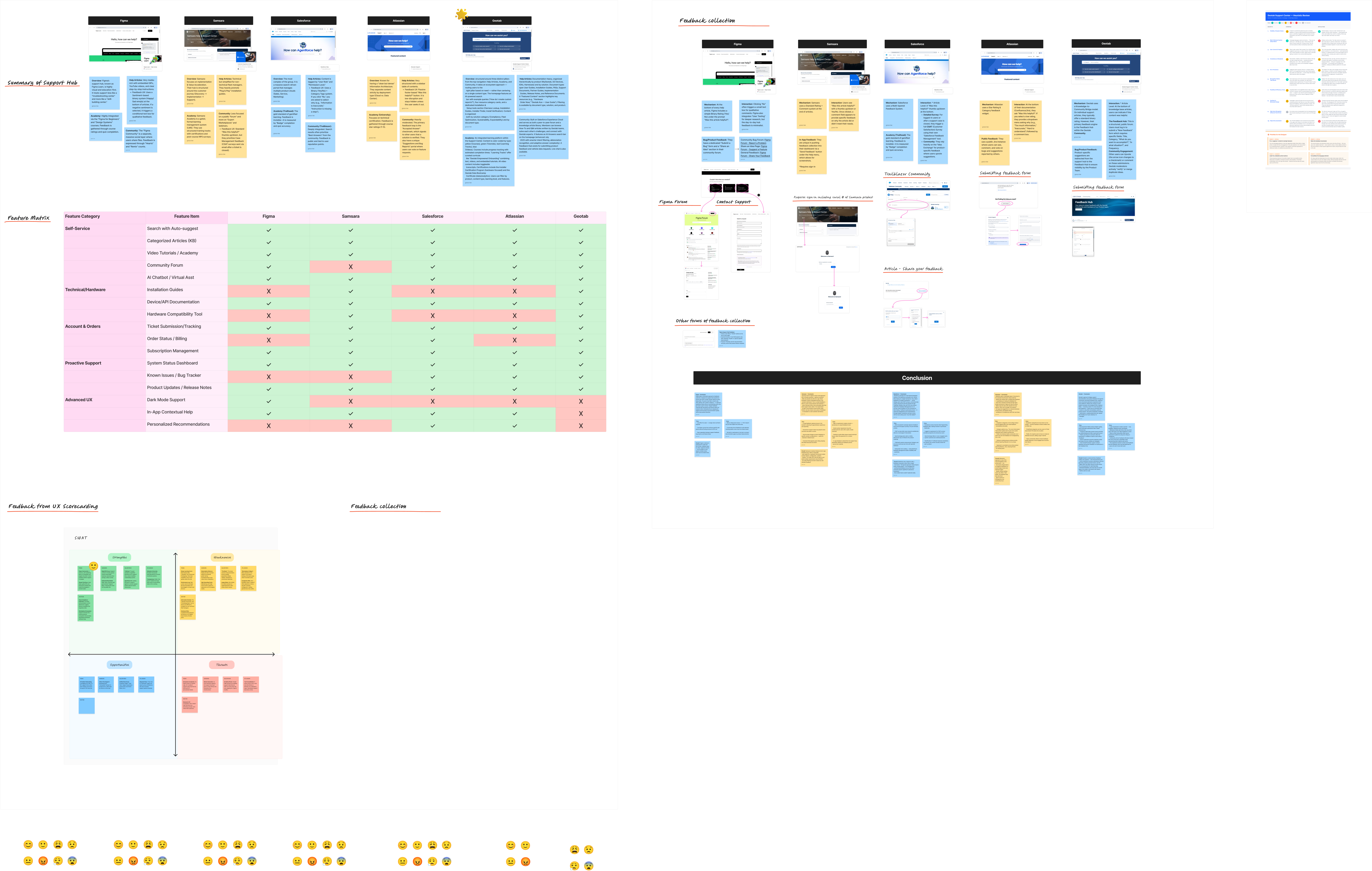
Alongside the data work, I ran a structured research phase covering the user journey, the competitive landscape, and the platform's baseline UX quality.

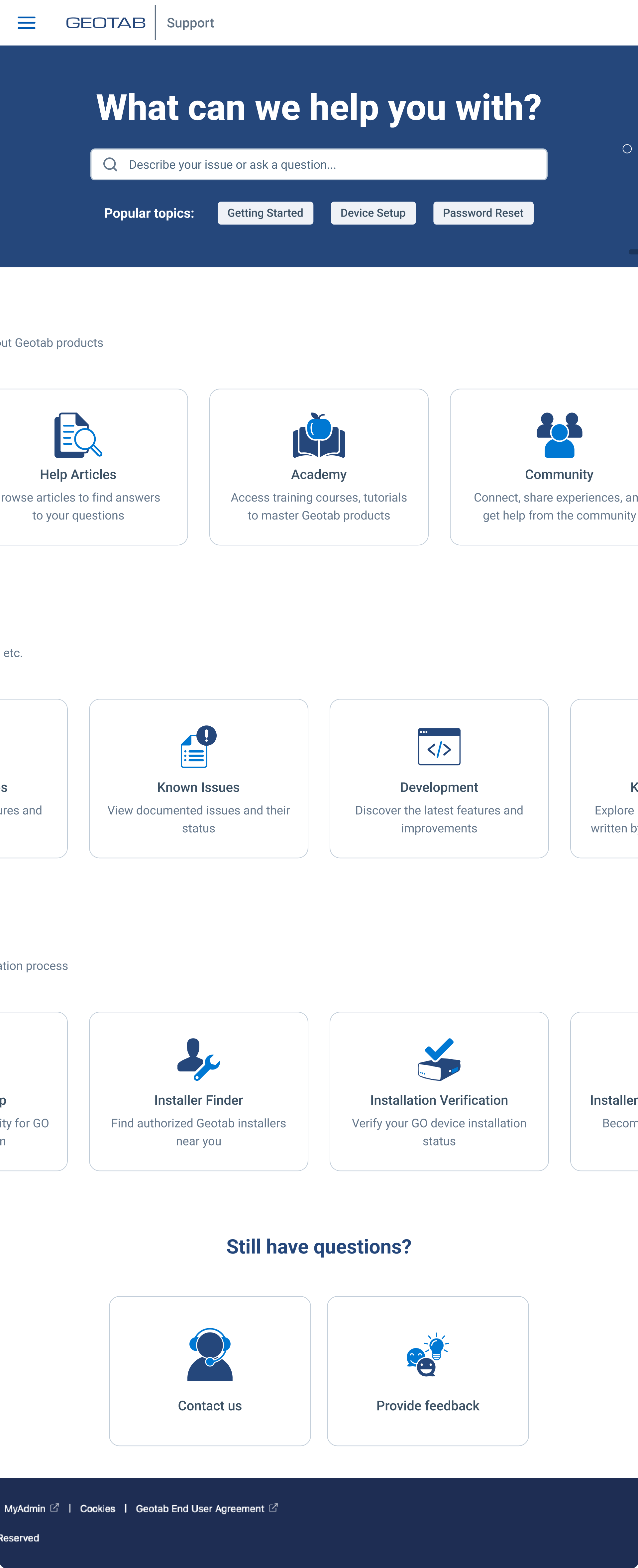
The support site homepage was redesigned from the ground up into a single, AI-powered entry point. Natural language search ("Describe your issue or ask a question…") replaces the old fragmented navigation. Popular topics surface the top ticket categories (Getting Started, Device Setup, Password Reset) — chosen from the ticket data, not guessed. Resource cards consolidate all six systems (Help Articles, Academy, Community, Known Issues, Development, Installer Finder) into one screen.

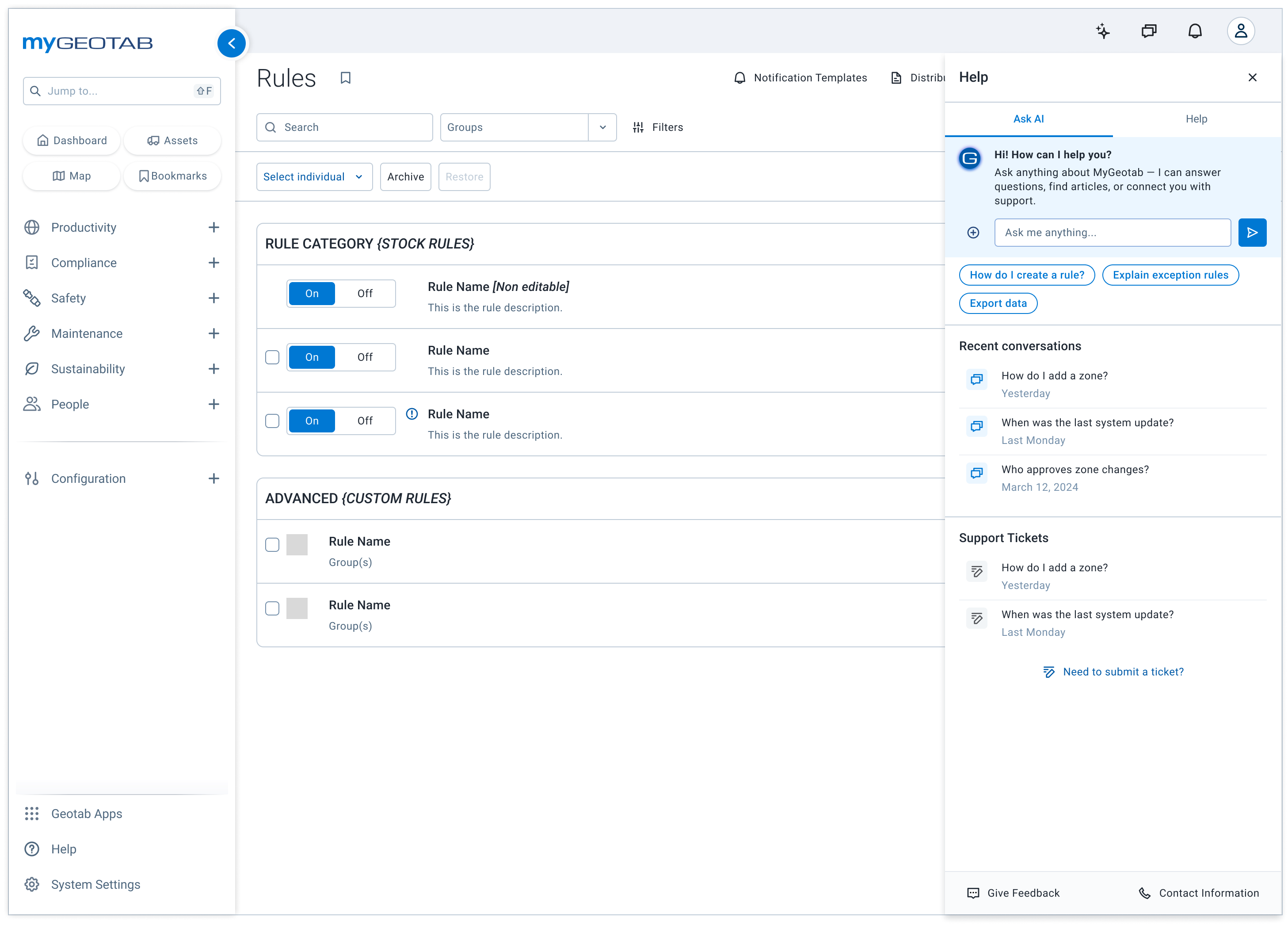
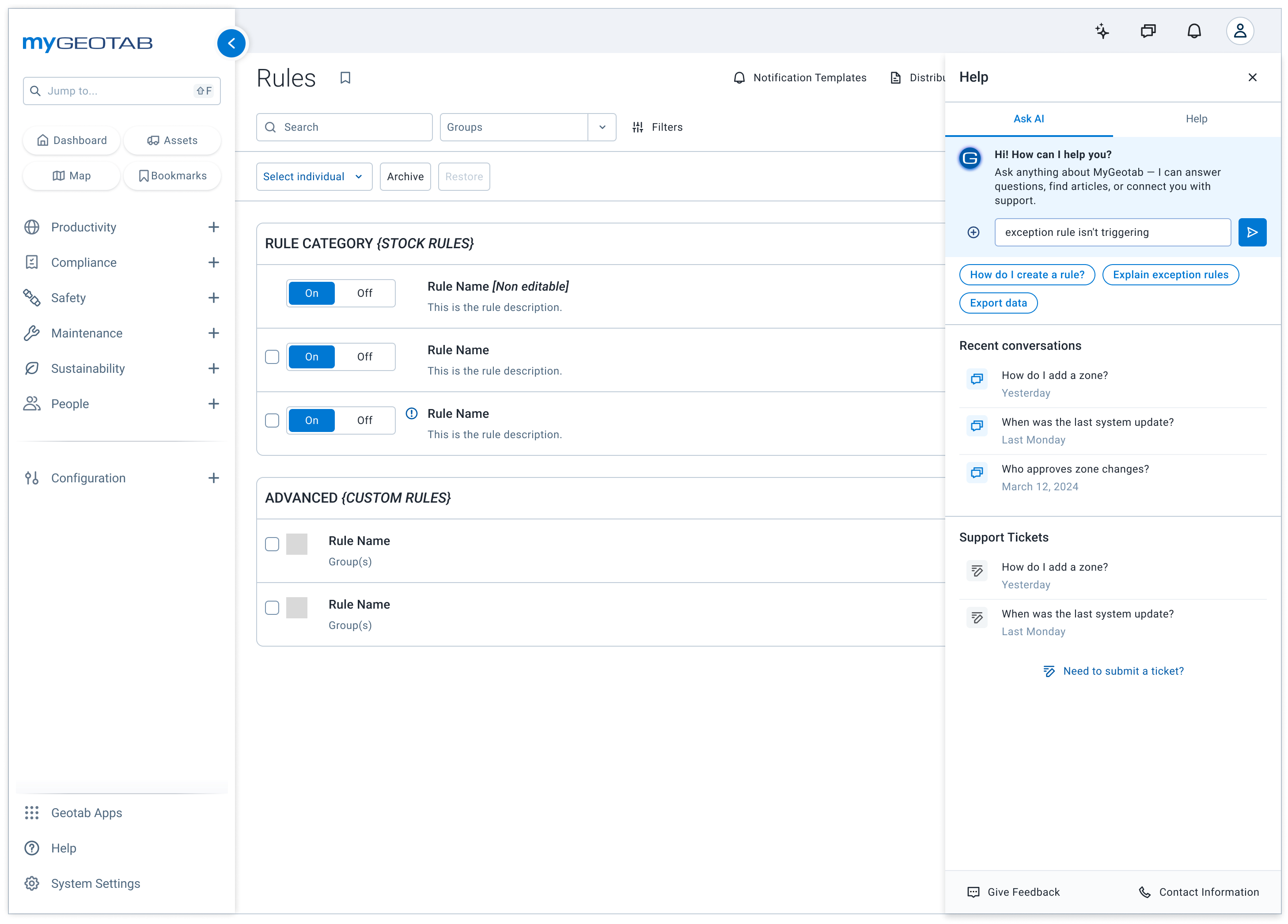
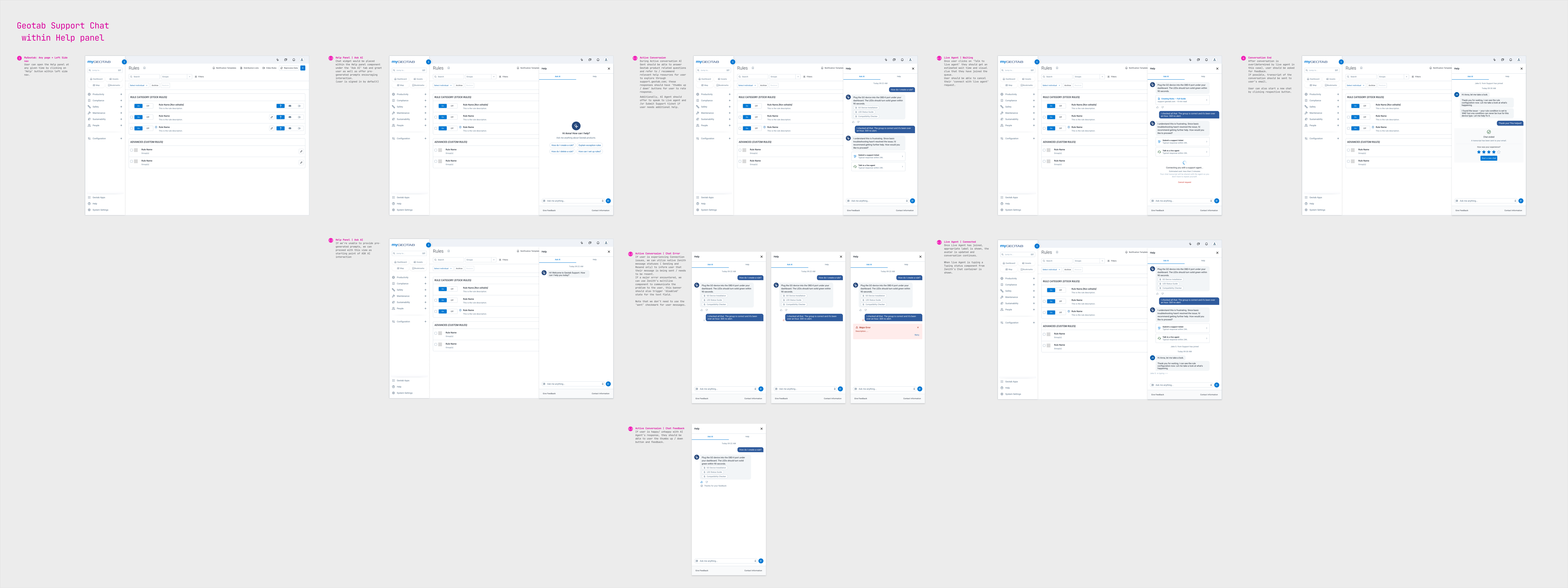
The Help panel slides out from within MyGeotab — no tab-switching, no leaving the workflow. It has two modes: Ask AI (natural language query with suggested prompts contextual to the current page) and Help (curated articles). It surfaces recent conversations, open support tickets, and a direct path to submit a new ticket — all without leaving the application. The contextual prompt suggestions ("How do I create a rule?", "Explain exception rules", "Export data") are generated from the page the user is currently on.
The agent-side of the loop. Before GIA for Support, agents juggled three separate windows (Salesforce, MyGeotab, and the knowledge base) while on a call — copying case details by hand, searching KB manually, and relying on memory for resolution steps. The GIA for Support console replaced that with a single panel: AI-drafted case notes, session-based handle-time tracking, AI-detected safety and priority signals, and the KB surfaced inline. From v1 to v17 across multiple months of iteration with the Support Operations team. Mandatory rollout to all regions.
The initiative moved into Phase 4 execution in July 2026. The Community migration to the Central Support Hub went live on July 15, 2026, with 15,000+ URLs redirected across 10 languages. Vertex AI Search is being rebuilt across Heretto, Strapi, and Dozuki content pipelines. And I'm running two new research tracks:
Central Support Hub launched January 2026 — live at support.geotab.com, serving all regions. GIA for Support shipped with a mandatory rollout — all agents, all regions. The Support UX Insights report became the shared, costed P0/P1 roadmap with Support Operations, establishing CES + revenue-at-risk as the joint success metric for support UX — not just a design metric, but an ops metric.